
Gentechnisch veränderte Pflanzen - Spezial
Die dunkelblaue Tomate „Purple Tomato“
Die gentechnisch veränderte “Purple Tomate”
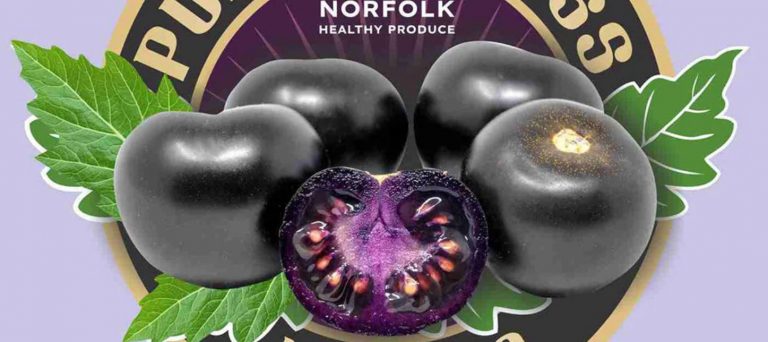
Nach Mitteilung des ► Saatgutunternehmens Norfolk Healthy Produce und des Vertriebsunternehmens All Aussie Farmers om 21.01.2026 hat die gentechnisch veränderte „Purple Tomate“ alle erforderlichen Genehmigungen für den kommerziellen Verkauf in Australien erhalten. Die Purple Tomato™ erhält ihre dunkelblaue Farbe durch Anthocyane, die durch zwei eingeführte Gene aus dem Löwenmäulchen (Antirrhinum majus) stark vermehrt gebildet werden. Die Hauptkomponente ist das Dephinidin. Anthocyane haben antioxidative Eigenschaften. Die Purple Tomate ist sowohl ein gentechnisch verändertes als auch funktionelles gesundheitsförderndes Lebensmittel.
Die australische Gentechnologiebehörde hat nun ► die Lizenz für die Freigabe der Tomate erteilt, nachdem ► die Food Standards Australia New Zealand (FSANZ) das Produkt Mitte letzten Jahres für sicher für den Verzehr erklärt hatte.
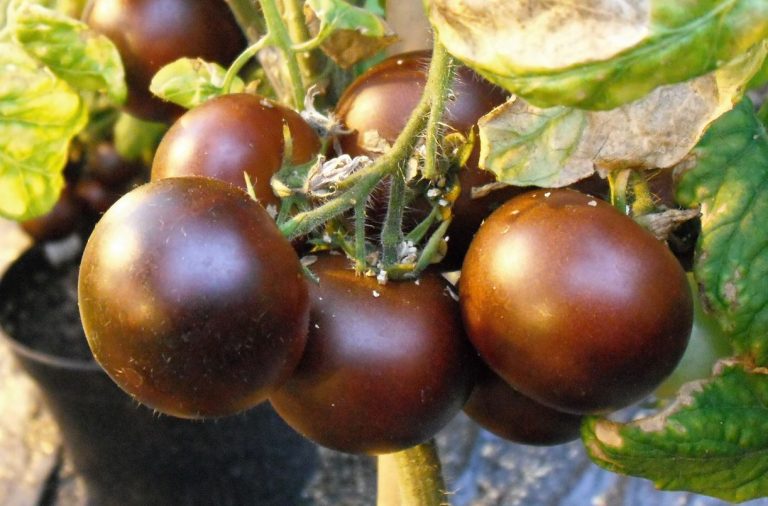
Event-Name: Del/Ros1-N
Eingeführte Gene.:
del codierend für das Delila-Protein, ein Transkriptionsfaktor, der mit den Proteinen Rosea 1 und WDR1 interagiert, um die Blütenpigmentierung zu regulieren.
ros-1 codierend für das Rosea-1-Protein, ein MYB-Transkriptionsfaktor, der das Muster und die Intensität der Färbung von Löwenmäulchenblüten steuert. Zusammen mit anderen Transkriptionsfaktoren wie DELILA reguliert ROSEA1 die Anthocyan-Biosynthese hoch.
Die Purple Tomate wurde bereits 2023 in den USA als sicher bewertet und zugelassen. Die Zulassung beschränkt sich allerdings nur auf den Gebrauch von Hobbygärtnern. Sie ist somit nicht so umfassend wie diese in Australien.
Woodruff S. (2024): Gardeners can now grow a genetically modified purple tomato made with snapdragon DNA
https://www.npr.org/sections/health-shots/2024/02/06/1228868005/purple-tomato-gmo-gardeners
Literatur:
Martin C., Butelli E. (2024): The Purple Tomato Story; From Laboratory Bench to the Consumer. ACS Food Sci Technol. 5 (1):19–28. doi: 10.1021/acsfoodscitech.4c00692
A world apart from academic research, the path from developing a polyphenol-rich crop to a product available to consumers is not one taken by many research scientists. Here we review the steps taken to commercialize anthocyanin-enriched purple tomatoes in the USA. In describing some of the difficulties encountered and the work that was necessary for a successful commercial launch of a new biotech product, we hope to encourage others to believe that there is a viable route to market, and an appetite for polyphenol-enriched foods that can protect health.
https://pubs.acs.org/doi/10.1021/acsfoodscitech.4c00692
Menconi J., Pierdomenico Perata P., Silvia Gonzali S. (2024): In pursuit of purple: anthocyanin biosynthesis in fruits of the tomato clade. Trends in Plant Science 29 (5), 589-604 | https://doi.org/10.1016/j.tplants.2023.12.010
Over the past decade, progress has been made in the characterization of anthocyanin synthesis in fruits of plants belonging to the tomato clade. The genomic elements underlying the activation of the process were identified, providing the basis for understanding how the pathway works in these species. In this review we explore the genetic mechanisms that have been characterized to date, and detail the various wild relatives of the tomato, which have been crucial for recovering ancestral traits that were probably lost during evolution from green-purple to yellow and red tomatoes. This knowledge should help developing strategies to further enhance the status of the commercial tomato lines on sale, based on both genome editing and breeding techniques.
https://www.sciencedirect.com/science/article/pii/S1360138523003953
Colanero S., Perata P., Gonzali S. (2020): What’s behind Purple Tomatoes? Insight into the Mechanisms of Anthocyanin Synthesis in Tomato Fruits.
Plant Physiol. 182 (4):1841–1853 | doi: 10.1104/pp.19.01530
https://pmc.ncbi.nlm.nih.gov/articles/PMC7140959/